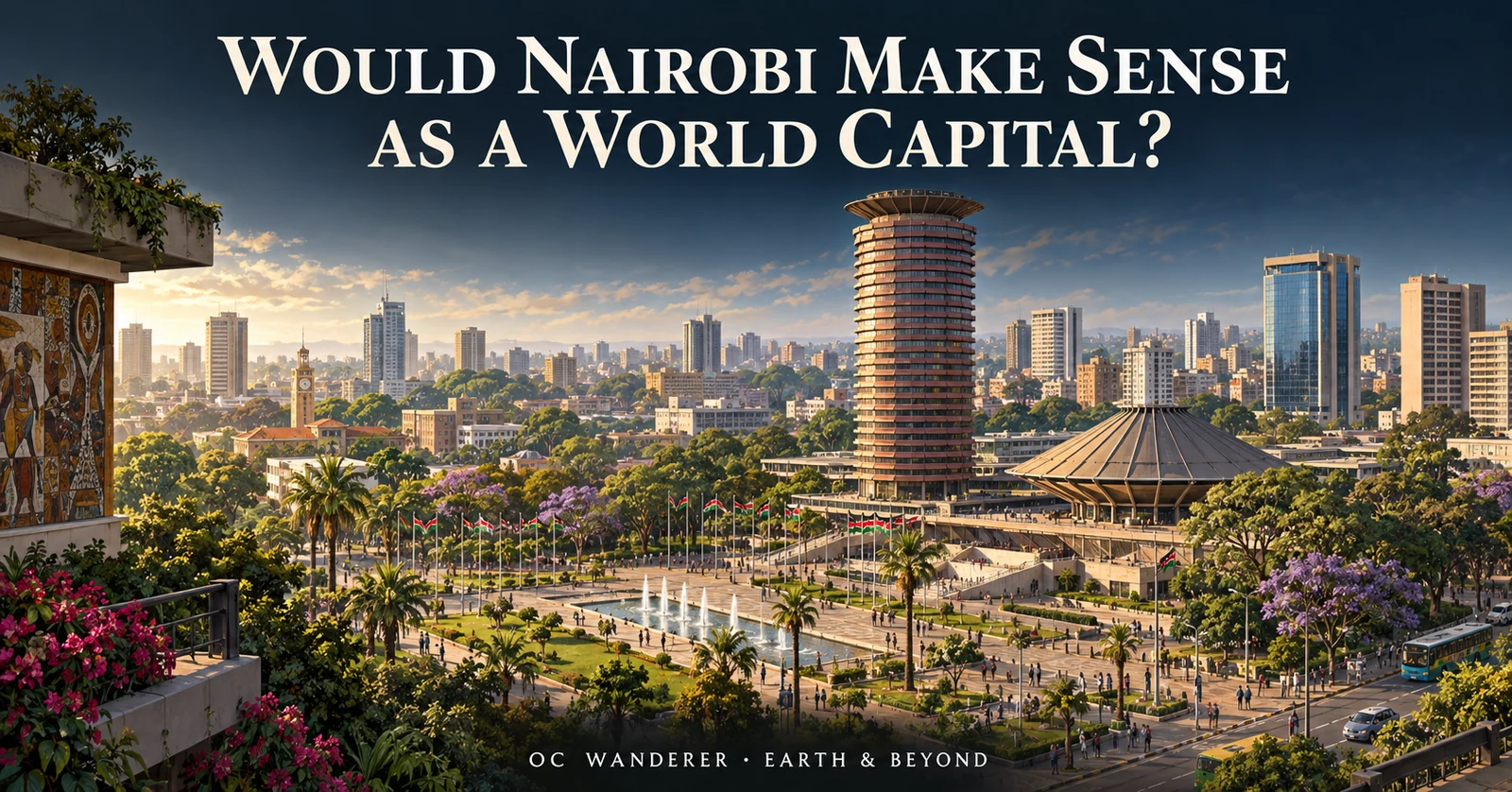
Would Nairobi Make Sense as a World Capital?
By O.C. Wanderer ·
nairobi, world capital, capital cities, capital relocation, united nations environment programme, canberra, brasilia, washington dc, host country agreement
Written by OC Wanderer, author of Destiny Among the Stars, a LitRPG sci-fi series set in the real stellar neighborhood. Published November 11, 2026.
A world parliament has to meet somewhere. The chamber we pictured for ten billion voters is one level of government among several. Its members each speak for millions, while most of what touches a person’s life is still decided in her town and her country. Imagine giving that chamber an address. Most of humanity would live far away, yet one city would have its delegates, diplomats and arguments arriving every day. Where on Earth would you put it?
If a world republic did form, where would people go to challenge it? When I imagined a civilization reaching beyond Earth, I pictured a planetary government and immediately wondered how one could work, all the way down to the city it would be run from. Its capital would bring jobs, security barriers, diplomats, protests, and enormous influence to its host city. Choosing the city would mean choosing whose streets fill with motorcades and whose neighbors have to walk around the barriers. Every other country would be watching what the host gained. I wonder who would have the standing to make that choice, and whose daily life would change when the answer arrived.
In Destiny Among the Stars the seat ends up in Nairobi, and I think Nairobi would make sense for a real world government too. The interesting part is the bargain that could make the choice acceptable. Nairobi already hosts international institutions, and a growing share of humanity lives on its continent. Could that existing city give the republic a home without handing another prize to the old great powers? And could the bargain serve Nairobi’s residents as well as the delegates? The republic I wrote is a level of government added on top of its countries, so its capital has to be a guest in one of them, and every other member would want a say in what the host gains.
Why did Australia put its capital a hundred miles from Sydney?
Australia’s answer is wonderfully specific: put the capital in Sydney’s state, but keep it a hundred miles away from Sydney. When the colonies joined in 1901, Sydney and Melbourne each wanted the capital. Their compromise made it into the constitution. The seat of government had to be in New South Wales, which is Sydney’s state, and “distant not less than one hundred miles from Sydney,” on territory that belonged to the national government. Melbourne got the years in between: “The Parliament shall sit at Melbourne until it meet at the seat of Government.”1 Parliament opened in Canberra in 1927, after 26 years in Melbourne.2
The United States had made a similar bargain a century earlier. Its Constitution provided for a federal district, “not exceeding ten Miles square,” on land given up by the states.3 Congress met in New York, then Philadelphia, before moving to Washington. The Potomac site was settled by a deal in 1790, with the details in note 4.4
Brazil planned its move for almost seventy years, then built Brasília on new ground. Imagine how much patience that would demand of countries trying to put a world republic together while its government waited for a home.5
Moving power away from the biggest city has an intriguing possible payoff. Alan Potter found an association between capitals outside a country’s largest city and less internal conflict, both violent and nonviolent. His explanation is that the location makes it harder for one faction to dominate the government.6 Applied to a world capital, that idea points toward a city outside the world’s biggest urban centers. It is a worldbuilding inference, though: Potter studied countries, and Nairobi is Kenya’s largest city. There is also a less comforting reason to move. Knutsen and his colleagues found that autocracies relocated capitals far more often than democracies, especially under threat.7 I wonder which motive would win in a planetary republic: sharing access to power, or giving its leaders distance from people who might challenge them. Nairobi would put the halls inside an established city, where residents already have lives and reasons to object to what happens on their streets.
Put the seat in Washington, Beijing, or Brussels, and an existing power center gains the daily advantages of proximity. Kenya sits outside the group of powers that would fight over that prize. Kenya’s colonial history matters to that choice for me: it was under British rule from 1895 until 1963.8
When rival cities cannot agree on a third place, a country can end up dividing the seat between them. Bolivia fought a civil war in 1899, and the immediate cause was a demand to move the capital from Sucre to La Paz. The side based in La Paz won. Today the president and the legislature sit in La Paz, and Sucre keeps the courts and the title. The constitution still says, “Sucre is the Capital of Bolivia.”9
The republic in my book starts out divided the same way. In Book 4, Chapter 219, President Anderson stands at a window in Washington at dawn, with the deal for the republic’s two chambers finally agreed after weeks of negotiation: “The Parliament would convene in Brussels for winter sessions and Singapore for summer. The Senate would meet in Washington during winter and Beijing during spring. A rotating structure designed to prevent any single nation from claiming dominance.” The next paragraph ends: “One government, four capitals. At least nobody could accuse him of playing favorites.”
Nairobi has hosted the United Nations Environment Programme’s headquarters since 1973
Nairobi has already won a smaller version of this argument. Kenya pointed out that the other headquarters were all in North America and Western Europe. On December 15, 1972, the General Assembly voted 128 to 0 to put the UN’s new environment programme in Nairobi. It opened there in October 1973 and still has its campus in the city.10
That campus is now one of the four main offices of the United Nations, with New York, Geneva and Vienna, and the only one of the four in Africa. It holds the headquarters of the environment programme and of UN-Habitat, the UN’s programme for towns and cities, on land that Kenya’s government donated. More than 70 UN offices and programmes work from the campus,11 and on May 12, 2026, the UN broke ground there on a conference-facility expansion.12
That gives the imagined republic something useful to build around: a city already accustomed to delegates arriving to do shared work. Much of what countries run together today was built by treaty, one body at a time, and each body had to be put somewhere. Some of them have been put in Nairobi for half a century, so the city already has people and institutions accustomed to hosting international work.
Africa also holds a growing share of the people a world government would answer to: about 19 percent of the world’s people live there now, and the United Nations projects about 37 percent by 2100.13 I wonder whether a seat in Africa would give people who have had less access to international power a greater claim on the institution that governs them.
In the book, the United Earth Republic (the UER) ends up with a single seat. Book 5, Chapter 292 looks back on the choice: “The UER had chosen Nairobi as its seat the day Earth finally unified, the Planetary Control Tower rising over the city while the last holdout signed in.”

What would Kenya and Nairobi get for hosting it?
What happens when Kenyan officials need to enter a UN campus in their own capital? That question already has a written answer. On March 26, 1975, Kenya and the United Nations signed the agreement setting the terms for the environment programme’s headquarters. Kenyan officials may enter it only with the consent of the programme’s director. Kenya provides police at its boundary and sees that it is supplied with electricity, water and sewerage “on equitable terms.” A dispute the two sides cannot settle goes to three arbitrators, one picked by each side and a chairman picked by those two.14 A planetary capital would need to settle those same questions on a much larger scale: who gets through the gate, who supplies the water, and who hears a dispute when the host and its guest disagree.
Then there is the person whose home ends up inside that district. Australia, the United States and Brazil each put their capital in a district outside their states. The residents’ political rights depend on the terms, and two capitals show how different those terms can be. A 2020 report for Congress counted more than 700,000 residents in Washington’s district, with one delegate who could not vote in the House of Representatives and no senators.15 Brazil’s Federal District elects its own governor and three senators, the same number as each Brazilian state.16
For Nairobi, the bargain would also have to fit Kenya’s constitution. Its first article begins, “All sovereign power belongs to the people of Kenya and shall be exercised only in accordance with this Constitution.” It lets the state take property for a public purpose only with “prompt payment in full, of just compensation” and a right to go to court.17 Those provisions constrain how public authority could be exercised and land acquired for a capital district. The people living and working around the site would bear its changes first. I would want the plan to say who keeps a home and who gets a voice when the new authority and the city disagree. For someone challenging the republic, access to a court and an answer about who represents them would matter as much as an address for its parliament.
The plumbing makes the stakes painfully concrete. A 2023 World Bank report, drawing on its 2016 urbanization review, puts Nairobi’s piped-water access at 84 percent of households in formal neighborhoods and 36 percent in informal settlements.18 A capital district with reliable utilities behind a fence could make that divide worse. A plan that extends water, transit, housing, and public space to the wider city could make the expense serve people who were there before the diplomats. That is the question I would ask about the republic’s spending: will someone outside the diplomatic district get a reliable water supply too?
In Book 4, Chapter 258, Luca sits in a conference hall in Nairobi on the day Earth’s unification is expected to reach one hundred percent, while the people who live in the city wait outside: “The flags of a hundred nations lined the hall, arranged to imply harmony had already been achieved. Outside the windows, Nairobi had not gotten the memo. A crowd of people had gathered along the conference perimeter who had come to be somewhere close when the number moved.”
So would Nairobi make sense as a world capital?
So yes, I think Nairobi would make sense, as long as the terms are settled with Kenya and with the people of Nairobi before the first hall goes up. I wanted to know where people would go to challenge a world government. I imagine them going to a city that was there long before the republic arrived, in a country outside the great powers, whose people would have to agree to the terms.
Give the republic its hall in Nairobi, and delegates from every country walk into it speaking their own languages. Which ones would the room work in? What Language Does a World Government Use, and What Happens to Everyone Else?
If you want to see the day a united Earth gets its capital, start Destiny Among the Stars.
Endnotes
-
Commonwealth of Australia Constitution, section 125, as published by the Parliamentary Education Office, “Chapter VII: Miscellaneous”: the seat of government “shall be within territory which shall have been granted to or acquired by the Commonwealth, and shall be vested in and belong to the Commonwealth, and shall be in the State of New South Wales, and be distant not less than one hundred miles from Sydney.” ↩
-
Parliamentary Education Office, “Why was Parliament House built in Canberra?”: the disagreement over Sydney or Melbourne, the compromise, the site chosen in 1908 and named Canberra in 1913, and the opening of Provisional Parliament House on May 9, 1927. Its history timeline dates the Seat of Government Act, which chose the site, to December 14, 1908. Author calculation: 1927 − 1901 = 26 years. ↩
-
Constitution of the United States, Article I, Section 8: Congress may “exercise exclusive Legislation in all Cases whatsoever, over such District (not exceeding ten Miles square) as may, by Cession of particular States, and the Acceptance of Congress, become the Seat of the Government of the United States.” ↩
-
Library of Congress, “Residence Act: Primary Documents in American History”: the act of July 16, 1790 chose a site on the Potomac River, made Philadelphia the temporary capital for ten years, and came out of a compromise among Thomas Jefferson, Alexander Hamilton and James Madison, in which Madison agreed not to block the assumption of the states’ debts. United States Senate, “Congressional Meeting Places”: New York City (1789–1790), Philadelphia (1790–1800), then Washington. ↩
-
Constituição da República dos Estados Unidos do Brasil (1891), Articles 2 and 3: a zone of 14,400 square kilometers on the central plateau is reserved for the future federal capital, and Rio de Janeiro remains the capital until the move. Agência Senado, “Brasília, uma história com mais de 200 anos,” April 20, 2007: the design competition of 1956, construction from 1957, and the inauguration by Kubitschek on April 21, 1960. Author calculation: 1960 − 1891 = 69 years. ↩
-
Alan Potter, “Locating the Government: Capital Cities and Civil Conflict,” Research & Politics 4, no. 4 (2017). The finding is an association across countries, and it concerns conflict inside a country. ↩
-
Carl Henrik Knutsen, Lee Morgenbesser and Tore Wig, “On the Move: Autocratic Leaders, Security, and Capital Relocations,” Political Geography 113 (2024): 103154. The authors use original data on capital relocations in 202 states after 1789. The threats they name are coups, popular protests and foreign interventions, and they also find that capitals are moved to smaller cities. ↩
-
United States Department of State, Office of the Historian, “Kenya”: British colonial rule from 1895 until independence on December 12, 1963. Embassy of the Republic of Kenya in Washington, “History”, gives July 1, 1895 for the start of formal British administration. ↩
-
Library of Congress country study of Bolivia, “The Liberal Party and the Rise of Tin”: in the “Federal Revolution” of 1899 the Liberal Party, based in and around La Paz, overthrew the Conservatives, and the immediate cause was the Liberal demand to move the capital from Sucre. Constitución Política del Estado (2009), Article 6: “Sucre es la Capital de Bolivia.” The translation is mine. Mauricio Ipiña Nagel, “The Bolivian Legal System,” GlobaLex, New York University School of Law, 2022: the executive and the legislature sit in La Paz and the head office of the judicial branch is in Sucre. ↩
-
United Nations Environment Programme, “How Nairobi Came to Host UNEP’s Headquarters,” March 3, 2022. The account of Kenya’s argument is the recollection of Donald Kaniaru, who was in Kenya’s delegation. The article records adoption on December 15, 1972, with 128 votes in favour, none against and no abstentions. ↩
-
United Nations Office at Nairobi, “Who We Are”: one of the four major duty stations of the United Nations, established in 1996, “the only UN headquarters in Africa and the Global South,” and host to the headquarters of the UN Environment Programme and the UN Human Settlements Programme (UN-Habitat). The donated land and the count of more than 70 offices and programmes are from the announcement in note 12. ↩
-
United Nations Office at Nairobi, “UN Launches Major Nairobi Expansion as Guterres Highlights Africa’s Growing Global Role,” May 12, 2026: new office buildings were inaugurated and ground was broken for a conference facility with a new assembly hall, in a project the announcement puts at $340 million. It gives no completion date. ↩
-
Institut national d’études démographiques, “Projections by continent,” from the medium scenario of the United Nations’ World Population Prospects 2024: Africa 1,550 million of a world total of 8,232 million in 2025, and 3,814 million of 10,180 million in 2100. Author calculations: 1,550 ÷ 8,232 = 18.8 percent; 3,814 ÷ 10,180 = 37.5 percent. ↩
-
United Nations and Republic of Kenya, “Agreement Regarding the Headquarters of the United Nations Environment Programme,” signed at Nairobi on March 26, 1975, United Nations Treaty Series 962, no. 13817: section 9 (entry only with the Executive Director’s consent), section 10 (police protection), section 12 (public services) and section 35 (arbitration). ↩
-
Congressional Research Service, “District of Columbia Statehood and Voting Representation,” In Focus IF11443, updated June 29, 2020: more than 700,000 residents, one nonvoting delegate in the House, no representative in the Senate, and votes for presidential electors under the Twenty-Third Amendment. ↩
-
Constituição da República Federativa do Brasil (1988), Article 18, paragraph 1 (“Brasília é a Capital Federal”), Article 32, on the Federal District and the election of its governor, and Article 46, paragraph 1: each state and the Federal District elect three senators. ↩
-
Constitution of Kenya, 2010, Article 1(1) and Article 40(3). ↩
-
World Bank, “Second Kenya Urban Support Program: Program Appraisal Document,” report PAD5054, May 24, 2023, page 9, paragraph 6. The appraisal takes the figures from the World Bank’s Kenya Urbanization Review of 2016. ↩
Related Posts
- Does Regionalism Always Tear Large Federations Apart, or Can It Be Managed?
- Can France Still Be France Inside a World Republic? The Autonomous Member State Problem
- Why Do National Identities Survive Inside Larger Unions, and What Does That Mean for a World Republic?
- What Language Does a World Government Use, and What Happens to Everyone Else?
- Can a Democracy Actually Function at the Scale of 10 Billion People?