What Would a World Government Actually Look Like? Federal, Parliamentary, Unitary, or Something Entirely New?
By O.C. Wanderer ·
world government, federalism, spain autonomous communities, german basic law, bicameral legislature, parliamentary government, constitutional design, european union withdrawal
Written by OC Wanderer, author of Destiny Among the Stars, a LitRPG sci-fi series set in the real stellar neighborhood. Published November 6, 2026.
Imagine the first interstellar survey ship coming home to Earth. Its crew might still be French, Kenyan, Brazilian or Indian, even if a planetary government sent them. In asking how a world government would form, I was drawn to unions that kept their members in place. Now I want to picture the authority above those members: what could it decide, and what would the countries still decide for themselves?
When I imagine humanity traveling among stars, I wonder about the people who would send the ships. They would leave from an Earth divided among countries, each with its own laws and priorities. For a civilization that means to keep exploring and building beyond Earth, wouldn’t we eventually need a planetary government? And if we did, how could it govern without making every country a province of one capital? I started by assuming the ships would need one government behind them, and then found I could not picture it. Would it divide powers between levels, answer to a parliament, concentrate authority in one capital, or need a combination nobody has tried at planetary scale?
My best guess is a federation with another layer added above the countries. That is the arrangement I explore with the United Earth Republic in Destiny Among the Stars: France and Kenya keep governing themselves while a planetary authority takes on jobs that cross borders. The exciting puzzle is how to make that authority strong enough to send the ships while giving its members real ways to challenge it. Existing federations offer pieces of the design, including written powers, representation for people and regions, and constitutional limits that the center has to respect.
Spain was run from one capital, and then gave its regions powers of their own
Spain makes the stakes of that design tangible: even the language people use can become a question of who holds power. After the civil war of 1936 to 1939, Franco centralized government in Madrid and revoked regional rights, including language rights recognized for Catalan, Basque and Galician speakers.1 In a unitary arrangement, ultimate authority rests at the center, which can create regional governments and take their powers back. Scale that question up to Earth, and I can see why prospective members would want more than a promise that the new capital will be considerate.
After Franco’s death in 1975, the constitution approved in 1978 offered a different bargain: it “recognizes and guarantees the right to self-government of the nationalities and regions” of Spain. Regions could take over matters including planning, health and teaching their own language, while defense, international relations and the monetary system stayed with the center.2 The division is interesting because it reaches into ordinary life. People could share a state while gaining room to govern the things closest to home.
The Basque Country and Catalonia received the first statutes of autonomy in 1979, and by 1983 Spain had seventeen self-governing communities, each with its own parliament and government. Spain’s government now describes the country as “one of the most decentralised countries in Europe.”3 That is a remarkable transformation to consider when imagining Earth’s future: the location of political power can change without requiring everyone to acquire one shared identity.
Spain moved toward a federal kind of arrangement, although its constitution does not call it a federation. The attraction of federalism is that regional powers have constitutional protection; the center cannot simply withdraw them on its own. A confederation leaves the last word with its members, as the American league did before the new constitution. Roughly 25 countries are federations today, holding 40 percent of the world’s population.4 These are familiar tools with enormous reach already. The challenge is choosing how much authority a planetary version should share.
Belgium and India offer different ways of making room for their members. Belgium began as a centralized state operating almost entirely in French, then reformed itself into a country whose constitution opens, “Belgium is a federal State composed of Communities and Regions.” India calls itself “a Union of States” and assigns subjects including police and public health to the states.5 Spain, Belgium and India each give regional governments powers of their own. That makes me hopeful that a world government could leave its countries governing much of daily life too, though three countries cannot settle the planetary question. Spain is close to how I picture the United Earth Republic: autonomous regions with their own taxes, policies and cultural identities, within a federal republic.
Germany’s constitution lists the federal powers and leaves the rest to its states
Germany offers an appealing starting rule for that bargain. Article 30 of its Basic Law leaves “the exercise of state powers and the discharge of state functions” to the Länder, its sixteen states, unless the constitution provides otherwise.6 The center has to find its authority in the constitutional rules. For a country considering a world republic, I imagine that default would matter enormously: joining would not hand every unmentioned job to the planetary capital.
The federal list includes familiar cross-border work: foreign affairs and defense, citizenship and immigration, money, international trade and air transport. There are also subjects where both levels may legislate. After 77 years under the Basic Law, the chamber representing the states says only a few areas remain with them, “for example education, culture, police and administrative law.”7 That complicates the comforting picture of a short powers list. A world republic might begin with narrow ambitions and still find its authority reaching into more of its members’ lives as common problems accumulate.
Madison described the proposed American federal powers as “few and defined,” and I expect a world government’s list would need to begin short, with every item fought over.8 Imagine France negotiating what belongs on that list: schools, taxes, courts, perhaps the rules for its own companies. How much could France keep governing for itself? That is where the constitutional design would become a very personal question for its citizens.
Space makes the question especially vivid. Fifteen governments already cooperate on the International Space Station under a treaty that lets each partner retain “jurisdiction and control over the elements it registers and over personnel in or on the Space Station who are its nationals.”9 Picture working together in orbit while different parts of the station and different crew members remain under different national authorities. A single space government is therefore an imagined choice, not a prerequisite for cooperation. In Destiny, the UER holds approval power itself: in Book 1, Chapter 12, a French company seeking an orbital manufacturing plant must go before a planetary board, “and since the UER required its approval for anything in cislunar space,” the space between Earth and the Moon, “it also had to appear before the Orbital Construction Licensing Board.”

Who votes in a world legislature, and who can remove its government?
Who gets a vote on those planetary rules? That question nearly broke up the American constitutional convention in 1787. Large states wanted seats in both chambers assigned by population; small-state delegates insisted on an equal vote in at least one. The July 16 compromise gave the House population-based representation and the Senate “two Senators from each State.”10 I can picture much the same tension in a room full of national delegates: everyone supports representation until someone begins counting whose votes will matter most.
Brazil makes the imbalance wonderfully easy to picture. São Paulo has about seventy times Roraima’s population, but both elect three senators; population counts instead in the Chamber of Deputies, where representation is roughly proportional.11 A resident of the larger state and a negotiator from the smaller one can look at the same arrangement and see very different bargains. Imagine negotiating that compromise across Earth.
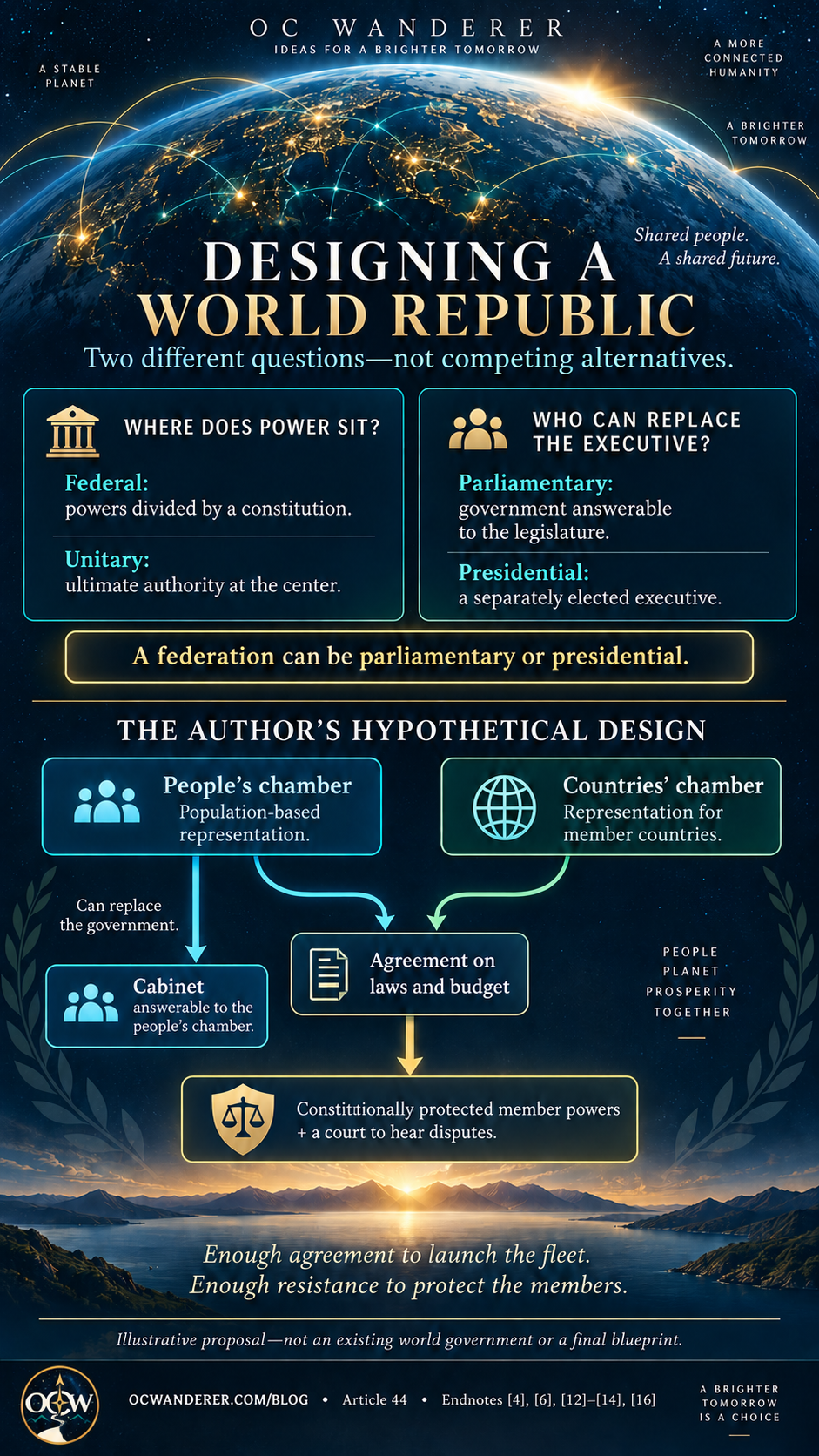
I would want a world legislature to represent both people and countries. Population-based seats alone could let a coalition of the most populous members dominate; equal national votes alone could give a coalition of small countries enormous power over everyone else. Requiring agreement from both chambers could make each coalition bargain with the other. That means majorities of representatives in each chamber, not a guarantee that a law has the personal approval of most humans on Earth. The price is slower change: adding bodies whose agreement is required, especially when their positions differ, reduces the room for a new policy.12 For my imagined republic, that creates a deliciously difficult problem: enough resistance to protect its members, yet enough agreement to launch the fleet.
In Destiny, President Anderson plans both chambers without seats for the countries. In Book 4, Karen Stevens, who runs the company that sent the crew’s ship out, tells them what he is about to announce, a legislature whose seats follow the towers that defend each region: “He’s establishing a UER Parliament and Senate, with representation by Regional Tower coverage rather than national borders.”
Replacing the people at the top is a separate design choice. In Germany, the elected Bundestag chooses the chancellor and can remove one only by electing a successor; in 1982 it replaced Helmut Schmidt with Helmut Kohl. Brazil instead elects its president directly for a four-year term.13 A federation can use either a parliamentary or a presidential executive. The German rule particularly interests me: the assembly has to agree on someone to take over, rather than simply agreeing that it dislikes the current leader.
For a world government I would choose a cabinet answerable to the chamber elected by people, so that it could be replaced between general elections. The cost is the struggle to maintain or rebuild a parliamentary majority; losing support could trigger a change of government, with the constitution determining how replacement works. Imagine trying to assemble a new coalition while an interstellar expedition waits for instructions. The chamber of countries would still vote on laws and the budget, so the cabinet would also face the challenge of persuading members to fund their common ambitions.
How would a country refuse?
A member would also want to know what stops the planetary government from rewriting the bargain. Germany makes constitutional amendments require two-thirds majorities in both the Bundestag and the Bundesrat, where state governments sit, and declares amendments attacking the division into states or their role in federal lawmaking “inadmissible.” Federal-state disputes go to the Constitutional Court, half of whose judges the Bundesrat elects.14 Brazil likewise protects its federal form against abolition by amendment.15 These are fascinating constraints to give a fictional president: winning today’s vote would still leave things the officeholder cannot legally change.
The safeguards reinforce one another. A chamber for the members gives them a vote, a court can hear their challenge, and protected constitutional rules make the bargain harder to undo. Federal authority still needs a constitutional basis: the American supremacy clause covers laws “which shall be made in Pursuance thereof,” under the constitution itself.16 I like the tension this creates for a planetary story. A president could have the ambition and the votes for a sweeping project and still have to persuade a court that Earth’s government has the power to pursue it.
Then there is the most uncomfortable guarantee of all: a way out. The European Union’s treaty says, “Any Member State may decide to withdraw from the Union in accordance with its own constitutional requirements,” and the United Kingdom left on January 31, 2020.17 I wonder whether an exit clause would make countries more willing to join a world republic, knowing the commitment has a lawful escape route. It would also give its government a reason to worry about what happens when a member decides the bargain no longer works.
In Book 4, Chapter 182 of Destiny, Karen Stevens meets President Anderson in a conference room in Washington and asks whether he means it when he says the republic needs to unify. He answers that the System, the alien power that arrived on Earth and runs like a game, has given him the tools: “As UER President, I have System authority to restructure the government.” He goes on: “Could dissolve autonomous regions. Centralize power. Rewrite the constitution.” Karen asks why he hasn’t. “Because the moment I use them, China walks. India walks. Europe fractures. Half of Africa revolts. The UER only exists because the member states accepted it voluntarily.”
So what would a world government look like?
The government I can picture behind the ships is another level above the countries their crews come from, built from parts federations already use. I would give it a cabinet answerable to an elected chamber, while expecting its members to keep arguing over the powers list. What excites me is how much human friction survives in that picture: an orbital factory needs approval, a small country wants its vote to count, and a president has to hold a coalition together before a ship can leave. Perhaps that noisy, imperfect arrangement could carry a civilization outward while still leaving its people recognizable to one another.
One of its two chambers would be elected by everyone on Earth. Could a chamber chosen by ten billion people work? Can a Democracy Actually Function at the Scale of 10 Billion People?
If you want to meet a president who could centralize Earth by himself and holds back, start Destiny Among the Stars.
Endnotes
-
Julienne E. Grant, “Researching the Law of the Spanish Autonomous Communities,” GlobaLex, New York University School of Law, September/October 2025: after the civil war of 1936–1939 Franco “demanded political centralization, revoking many of the rights of Spain’s regions, including minority linguistic rights that had been recognized during the Second Republic”; the constitution of 1931 had acknowledged the right to use regional languages “such as Catalan, Galician, and Basque.” ↩
-
Spanish Constitution of 1978, English text published by the Spanish government: Preliminary Title, section 2, for the quotation; Part VIII, section 148(1) (town planning and housing, health and hygiene, and “where applicable, the teaching of the Self-governing Community’s language”) and section 149(1) (international relations, defence and the armed forces, the monetary system). La Moncloa, “Constitution”: approved by referendum on December 6, 1978 and in force from December 29. Franco’s death in 1975: Grant (note 1). ↩
-
Grant (note 1): the statutes of the Basque Country and Catalonia in 1979, Galicia and Andalusia in 1981, and the other thirteen communities in 1982 and 1983; the cities of Ceuta and Melilla received a statute in 1995. La Moncloa, “Spanish institutions”, for the communities’ parliaments and governments and for the quotation. ↩
-
Forum of Federations, “Countries”: “There are roughly 25 federal countries in the world today, which together represent 40 per cent of the world’s population.” The league of American states: National Archives, “Articles of Confederation (1777)”, Article II, under which each state “retains its sovereignty, freedom and independence.” Spain’s constitution does not use the word federation, and its section 149(3) leaves to the central government whatever a region’s statute has not claimed, the reverse of the German rule in the next section. ↩
-
Forum of Federations, “Belgium (country profile)”: Belgium “was created as a strongly centralized unitary state which operated ... almost completely in French,” and was federalized through reforms in 1970, 1980, 1988 and 1993. Belgian Constitution, Article 1, and Constitution of India, Article 1 and the Seventh Schedule, List II (“Police,” “Public health and sanitation”), English texts at the Constitute Project: Belgium, India. ↩
-
Basic Law for the Federal Republic of Germany, Articles 30 and 70(1), official English translation published by the Federal Ministry of Justice, which includes amendments through the Act of March 22, 2025. Article 70(1) says the states “shall have the right to legislate insofar as this Basic Law does not confer legislative power on the Federation.” The preamble names the sixteen Länder. ↩
-
Basic Law (note 6), Articles 73(1) and 74(1). Article 74 includes civil and criminal law, public welfare and labor law among concurrent subjects. Bundesrat, “Legislative procedure”, for the quotation. The two lists do touch schools and policing at the edges: Article 73 covers cooperation between the federation and the states in criminal police work, and Article 74 covers education grants. Author calculation: the Basic Law was adopted in 1949, and 2026 − 1949 = 77 years. ↩
-
James Madison, The Federalist No. 45, text at Yale Law School’s Avalon Project: “The powers delegated by the proposed Constitution to the federal government are few and defined.” ↩
-
Agreement Concerning Cooperation on the Civil International Space Station, signed at Washington on January 29, 1998, Article 5(2), reproduced in the schedule to Canada’s Civil International Space Station Agreement Implementation Act. Treaty text. The fifteen governments are Canada, eleven European states, Japan, Russia and the United States. ↩
-
U.S. Senate, “Equal State Representation”: the Virginia Plan made representation in both houses proportional to a state’s size; Roger Sherman of Connecticut said the smaller states “would never agree to the plan on any other principle than an equality of suffrage” in the Senate; the small-state delegates’ protests were “threatening to unravel the proceedings”; and “on July 16, delegates narrowly adopted the mixed representation plan giving states equal votes in the Senate.” Constitution of the United States, Article I, sections 2 and 3, National Archives transcription. ↩
-
Constitution of the Federative Republic of Brazil, Articles 45 and 46, English text at the Constitute Project: deputies are elected “in proportion to the population,” with no state having fewer than eight or more than seventy, and “each State and the Federal District shall elect three Senators for eight-year terms.” Populations: Instituto Brasileiro de Geografia e Estatística, 2022 Census, table 4714: São Paulo 44,411,238; Roraima 636,707. Author calculation: 44,411,238 ÷ 636,707 ≈ 70. ↩
-
George Tsebelis, “Decision Making in Political Systems: Veto Players in Presidentialism, Parliamentarism, Multicameralism and Multipartyism,” British Journal of Political Science 25, no. 3 (1995): 289–325. DOI. From the abstract: “The potential for policy change decreases with the number of veto players, the lack of congruence (dissimilarity of policy positions among veto players) and the cohesion ... of these players.” A veto player is an actor whose agreement a change requires. The article sets out a framework and reports that it agrees with existing empirical studies. ↩
-
Basic Law (note 6), Articles 38(1), 63(1) and 67(1). German Historical Institute, “Constructive Vote of No Confidence in the Bundestag (October 1, 1982),” German History in Documents and Images: the Bundestag elected Helmut Kohl chancellor in place of Helmut Schmidt. Brazilian constitution (note 11), Articles 77 and 82. ↩
-
Basic Law (note 6), Articles 79(2) and 79(3); Article 94(1), no. 3; Article 93(2), under which half of the court’s judges are elected by the Bundestag and half by the Bundesrat; and Article 51(1) on who sits in the Bundesrat. Article 79(3) protects the principles of Articles 1 and 20 in the same sentence. ↩
-
Brazilian constitution (note 11), Article 60: an amendment needs three-fifths of the members of each chamber in two rounds of voting, and no amendment may be considered that is aimed at abolishing the federal form of the state, the direct and secret vote, the separation of powers, or individual rights. ↩
-
Constitution of the United States (note 10), Article VI. The Tenth Amendment states the other half of the rule: “The powers not delegated to the United States by the Constitution, nor prohibited by it to the States, are reserved to the States respectively, or to the people.” Bill of Rights, National Archives transcription. ↩
-
Treaty on European Union, Article 50(1). European Parliament, “The United Kingdom,” Fact Sheets on the European Union: “The UK formally left the EU on 31 January 2020.” ↩
Related Posts
- Does Regionalism Always Tear Large Federations Apart, or Can It Be Managed?
- Can France Still Be France Inside a World Republic? The Autonomous Member State Problem
- Why Do National Identities Survive Inside Larger Unions, and What Does That Mean for a World Republic?
- What Language Does a World Government Use, and What Happens to Everyone Else?
- Would Nairobi Make Sense as a World Capital?