Does Regionalism Always Tear Large Federations Apart, or Can It Be Managed?
By O.C. Wanderer ·
regionalism, federalism, secession, india states reorganisation, bolivia autonomies, catalonia, soviet union, nigeria, self-rule, world government
Written by OC Wanderer, author of Destiny Among the Stars, a LitRPG sci-fi series set in the real stellar neighborhood. Published November 20, 2026.
Suppose France secures a protected place inside a world republic: powers in writing, a court to uphold them and a say before the terms change. Every other member would want a bargain of its own. Then a generation passes, interests diverge and a region comes back asking for more. How does Earth keep governing together when the agreement that brought it together no longer satisfies everyone?
I imagine a lasting civilization beyond Earth would need a planetary government behind it. That makes the arguments inside it fascinating to me. Humanity could agree to share a government and still disagree fiercely about how much power belongs in the capital. Suppose the speakers of one language want a government of their own, or a region discovers that the center has changed what it may decide for itself. The founding ceremony is long over, and now someone wants to renegotiate. Could the republic make room for that argument while keeping the union alive?
The cases give me reason to think it could. Regions need a lawful way to ask for new terms, and a reason to trust that self-rule will stay in place once granted. A union also has a better chance if no single member towers over the rest. Those conditions leave plenty of room for trouble, which is exactly what interests me about the United Earth Republic in Destiny Among the Stars. The republic is one more government set above countries that are still there, so a region with a grievance has one more place to take it. In Book 1, Chapter 12, Earth’s countries have joined the republic to fight monsters that an alien System sent through portals. The director of Internal Security tells the cabinet: “We’re tracking sixty-two separatist groups and half a dozen System cults.”
India redraws its states by law, and Bolivia rewrote its constitution
India’s map shows how painfully the demand for a voice can begin. In 1952 a man named Potti Sriramulu undertook a fast for a separate state for the speakers of Telugu, who were then governed as part of Madras State in southern India. He died that December. After his death India’s government announced that it would create the state, and Andhra came into existence in 1953.1
The government then appointed a commission to look at the whole map. Parliament acted on its report with the States Reorganisation Act of 1956, which redrew the states with each region’s language as an important factor.2 Think of the scale of that decision: people seeking a government in their own language helped push the union into rethinking its internal map.
The map kept changing through later reorganizations.3 India’s constitution gives Parliament a route for that work. Article 3 lets it form a new state, alter a state’s area or borders, or change its name by law. The president first sends the bill to the affected state legislature for its views, which do not bind Parliament. These laws do not count as constitutional amendments and need no special majority.4 A region can be heard without being able to stop the change. That is a consequential choice for any imagined republic: how much flexibility would Earth give its parliament, and how much protection would its members demand?
Telangana shows why a flexible map still leaves years of argument. In 1955 the commission recommended keeping the Telugu-speaking districts of the old Hyderabad State separate for the time being, with a conditional path to joining Andhra later. The 1956 act joined them at once as Andhra Pradesh. Parliament separated them again in 2014, creating Telangana.5 An internal border could be redrawn within the union, yet people lived with the disputed arrangement for decades. I would expect Earth’s constitution to face that same uncomfortable question: who gets to decide when the waiting has gone on long enough?
Bolivia’s puzzle was different: what happens when the whole country rejects autonomy, but particular regions vote strongly for it? In 2006, before an assembly sat down to write a new constitution, Bolivians voted on whether that assembly should be bound to give the country’s departments self-government. The ballot said the answer would apply in each department where the yes vote won. The country as a whole voted no. Santa Cruz, the large department in the eastern lowlands, voted yes by 71 percent, and three other departments voted yes with it.6 The constitution Bolivia adopted in 2009 describes the country in its first article as a state “with autonomies.” It gives every department an assembly and a governor chosen by its own voters, and it says the departments that voted yes in 2006 pass directly to self-government.7 That split is what catches my imagination. The national answer and the local answer were both real, and the new constitution had to give those regional demands somewhere to go.
I like the possibility of a world republic whose internal map can evolve by law. An article like India’s would let the region concerned make its case before a vote of the planetary parliament. The countries beneath it would need a route for their own regions too, perhaps through a constitutional bargain like Bolivia’s. The exciting worldbuilding question is who gets heard at each level: a country asking Earth for more power, or a region asking that country for more power of its own?
In Book 4, Chapter 204 of Destiny, Luca’s crew goes to San Juan, Puerto Rico, to recruit a local team. Puerto Rico is the island where another team is rebuilding the Arecibo telescope. The San Juan team’s leader, Carlos, explains over dinner why his people are staying: “We’re working with the local government on infrastructure projects. Lobbying for increased autonomy within the UER structure.”

What happened in Catalonia after the 2010 court ruling?
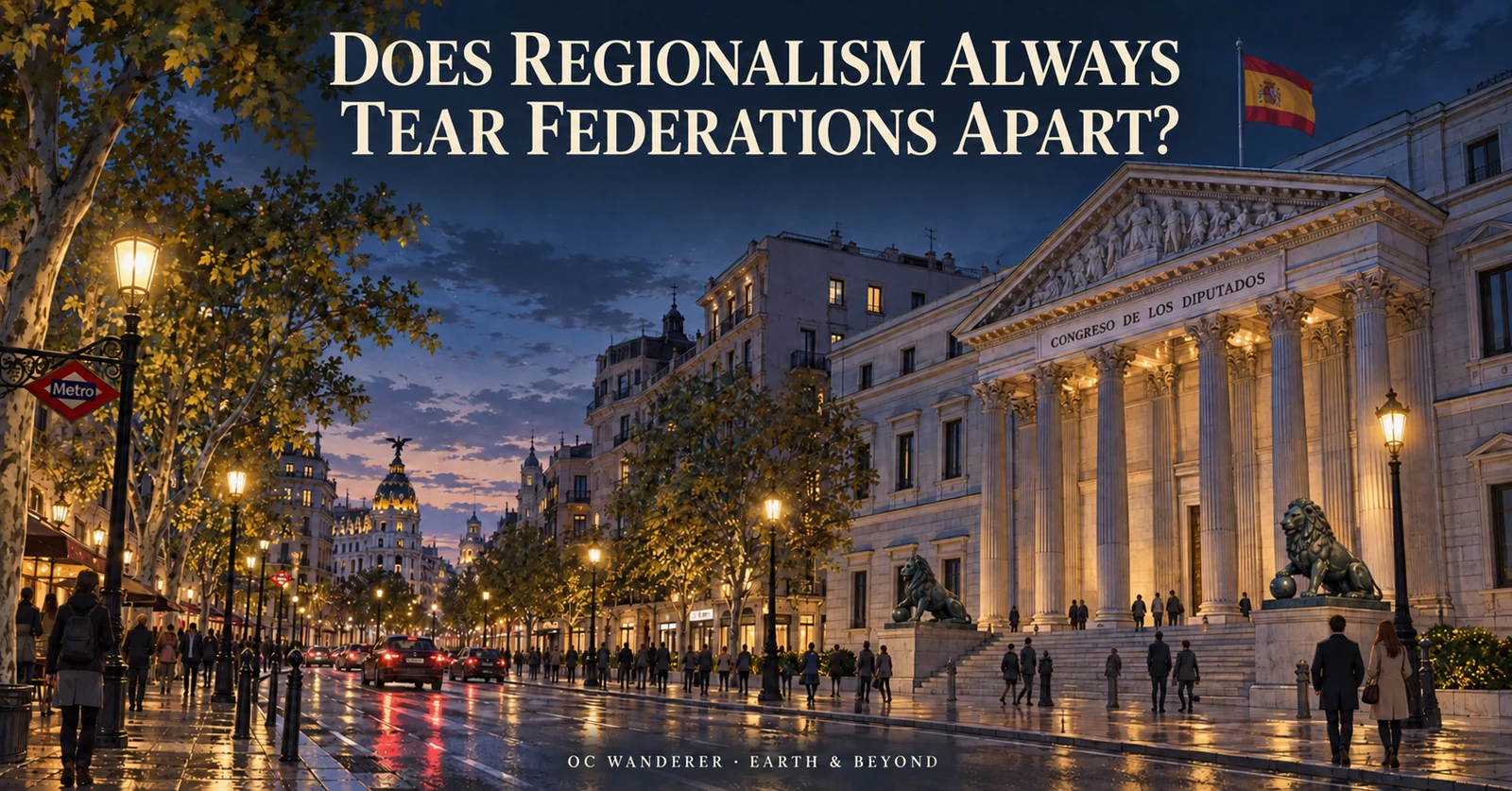
Catalonia got a new statute of autonomy in 2006. A statute is the law that sets out what one of Spain’s regions governs for itself, under the arrangement Spain’s constitution makes for its regions. This one had been passed by the Catalan parliament and by the Spanish parliament, and Catalan voters approved it in a referendum, with about three in four votes in favor on a turnout of just under half.8 Imagine voting for that agreement and believing the question of your region’s powers has finally been settled.
A group of members of the Spanish parliament challenged the statute before Spain’s Constitutional Court, and the court ruled in 2010. It struck down all or part of 14 articles, including the words that made Catalan the “preferential” language of the region’s public administration, and it ruled that the preamble’s references to “Catalonia as a nation” have no legal effect in interpreting the statute. It also listed further provisions that stand only when they are read the way the ruling sets out.9 The statute people had approved would now operate within boundaries drawn by the court. That is a very different experience from sitting down to negotiate a new bargain.
That July a crowd marched through Barcelona under the slogan “We are a nation. We decide.” In the Catalan government’s opinion surveys, support for independence rose from about one in five in early 2010 to nearly half by late 2013. A 2026 study examined the ruling as a perceived loss of self-rule. Comparing Catalonia’s votes for pro-independence parties with a stand-in built from other European regions, the authors concluded that the rise would not have happened without it.10 The comparison uses party votes rather than matching opinion surveys, so it is an indirect measure of the change. Even with that limit, this is an unsettling possibility for a world republic: a court can uphold its reading of the constitution while people in a region feel that their agreement has been broken.
The question becomes sharper when you separate having no self-rule from having it taken away. A study followed 324 ethnic groups from 1960 to 2000 and found that those which had lost autonomy were most likely to sustain a movement for separation, compared with currently autonomous groups and groups that had never governed themselves.11 The authors suggest a reason: self-government gives a group leaders and organization. Losing it supplies a grievance while weakening trust in the center’s next promise. A planetary minister might think withdrawing a region’s powers would make it easier to govern; the region could already have the people and institutions needed to organize against that decision.
People who describe themselves by their nation alone were the least willing to support a wider union in the identity research. I wonder how many people would move toward that position after losing powers they thought were secure. A world republic’s center would have reasons of its own for cutting them back. My proposed bargain for France would require the region’s agreement, a stronger protection than India’s Article 3 gives its states. Now imagine the planetary cabinet facing an urgent problem and discovering that the region whose cooperation it needs can refuse the constitutional change.
In Book 4, Chapter 182 of Destiny, Karen Stevens, who runs the company that sent the crew’s ship out, tells President Anderson what is wrong with the republic’s regions: “Your governors are entrenched in regional loyalties, building personal power bases.” She has a remedy: “Send the Governor of New England to Manila. Send Manila to Monterrey. Break their power bases.” Anderson stares at her. “That’s exactly what I was afraid someone would suggest.”
Russia held more than half of the Soviet Union’s people
The size of a member can create another kind of challenge: its government may have enough weight to rival the union itself. In 1990 the Russian republic’s parliament declared that its own laws came before Soviet law and claimed the Soviet property on its territory. The Soviet Union was a federation of fifteen republics, each the home of a nationality, and the Russian republic held more than half of its people. After Soviet hard-liners tried a coup and failed, the government of the Russian republic’s elected leader, Boris Yeltsin, began taking over Soviet institutions. Ukraine’s leader wondered aloud whether union institutions dominated by Russia could “defend the interests of other republics.” In 1991 Ukraine voted for independence, and Russia, Ukraine and Belarus signed the treaty that dissolved the union.12
Nigeria had the same imbalance. At independence in 1960 it was a federation of three regions, and the Northern Region held about 55 percent of the people. Within a decade the eastern region tried to secede, and the country was in a civil war. As the old federation broke down, Nigeria’s military government divided the regions into smaller states, the North into six.13 Picture what that does to an internal map. Dividing the biggest member changes the balance inside the federation, while confronting its leaders with the loss of a single regional power base.
Hale tested that population imbalance in federations whose regions are associated with particular peoples. His dominant-region category included a member holding a majority or far more people than the next largest. Seven of fourteen federations with such a region collapsed through breakup or large-scale civil war; among thirteen without one, including India, Switzerland and Canada, he found no collapse.14 That is a striking historical pattern to build a question around. It makes me look at a proposed planetary map and ask whether one member could become a rival center of power.
If we treat the countries of a world republic as members associated with particular peoples, we can borrow Hale’s population test. On the UN’s 2023 figures, India and China were close to equal at about 1.4 billion people each and together held a little more than a third of the world. Neither would qualify as a dominant member under his rule.15 The republic could consider how to divide a chamber’s seats when one member is far larger than another, and seats can be capped for the largest members. But changing the size of a country itself would be a far bigger political demand. Nigeria’s answer to an oversized region was to divide it into several, and I wonder whether any country would accept that from a world government.
So does regionalism always tear large federations apart?
Regionalism can be managed, though these cases give a world republic plenty to worry about. India has a legal route for changing its map; Bolivia settled an autonomy dispute in a new constitution. Catalonia shows what can follow when people believe promised self-rule has been cut back. Hale’s comparison adds the danger of a member large enough to rival the union, within the particular kind of federation he studied. Those are possibilities to think with when imagining Earth’s government, rather than a guarantee that it would last. I can picture a republic surviving by making room for the next argument: new borders, protected powers, another negotiated agreement. Its members would keep returning to the same table because they still had something worth sharing.
Regional loyalties give the republic plenty of disputes before we even get to its other alliances. Who would join forces across those borders, and over what? What Factions Would Actually Exist Inside a World Republic, and What Would They Be Fighting Over?
If you want to meet a president who is told to break his governors’ power bases, start Destiny Among the Stars.
Endnotes
-
Government of India, Report of the States Reorganisation Commission, 1955, paragraphs 68 and 71: “After the death of Shri Sriramulu, the Government of India announced their decision to establish the State of Andhra ‘consisting of the Telugu-speaking areas of the present Madras State but not including the City of Madras’”; the state “came into existence on 1st October, 1953.” The fast is recorded by India’s upper house: Rajya Sabha Secretariat, Rajya Sabha at Work, chapter 16, page 477, notes that the chairman expressed sorrow “on the death of Shri Potti Sriramulu, who undertook fast for the formation of a separate Andhra Pradesh,” and cites the debate of December 16, 1952. ↩
-
Report of the States Reorganisation Commission (note 1), paragraph 163: the commission recommended recognizing “linguistic homogeneity as an important factor conducive to administrative convenience and efficiency” without treating it as “an exclusive and binding principle.” Government of India, States Reorganisation Act, 1956 (No. 37 of 1956), section 2(a): the act’s changes took effect on “the 1st day of November, 1956.” ↩
-
Government of India, Legislative Department, The Constitution of India, as on May 1, 2024, First Schedule and its footnotes: Gujarat’s territory is defined by the Bombay Reorganisation Act, 1960 (in effect May 1, 1960), and Haryana’s by the Punjab Reorganisation Act, 1966 (November 1, 1966). The three states of 2000 are Chhattisgarh, Uttarakhand and Jharkhand, created by the Madhya Pradesh, Uttar Pradesh and Bihar Reorganisation Acts of that year. ↩
-
The Constitution of India (note 3), Article 3: “Parliament may by law (a) form a new State by separation of territory from any State or by uniting two or more States or parts of States or by uniting any territory to a part of any State; (b) increase the area of any State; (c) diminish the area of any State; (d) alter the boundaries of any State; (e) alter the name of any State.” The proviso requires the president’s recommendation and a reference of the bill “to the Legislature of that State for expressing its views thereon.” Article 4(2): “No such law as aforesaid shall be deemed to be an amendment of this Constitution for the purposes of article 368.” Article 368 is the amendment procedure, which requires special majorities. The legislature’s views do not bind Parliament. ↩
-
Report of the States Reorganisation Commission (note 1), paragraph 386: “it will be in the interests of Andhra as well as Telangana if, for the present, the Telangana area is constituted into a separate State, which may be known as the Hyderabad State, with provision for its unification with Andhra after the general elections likely to be held in or about 1961, if by a two-thirds majority the legislature of the residuary Hyderabad State expresses itself in favour of such unification.” States Reorganisation Act, 1956 (note 2), section 3: “Transfer of territory from Hyderabad to Andhra and alteration of name.” The Constitution of India (note 3), First Schedule: entry 28, Telangana, “the territories specified in section 3 of the Andhra Pradesh Reorganisation Act, 2014,” in effect June 2, 2014. The schedule lists 28 states and 8 union territories. Telangana was the twenty-ninth state when it was created; the Jammu and Kashmir Reorganisation Act, 2019 turned one state into two union territories. Author calculation: 2014 − 1956 = 58 years. ↩
-
Corte Nacional Electoral (Bolivia), results of the binding national referendum of July 2, 2006, as published by Georgetown University’s Political Database of the Americas, “Bolivia: Referéndum Nacional Vinculante 2006”. The question asked whether to give the Constituent Assembly “el mandato vinculante para establecer un régimen de autonomía departamental, aplicable inmediatamente después de la promulgación de la nueva Constitución Política del Estado, en los departamentos donde este referéndum tenga mayoría.” Nationally: yes 1,177,312 (42.1 percent), no 1,620,017 (57.9 percent). Santa Cruz: yes 466,826, no 189,622 (71.1 percent yes). Beni (73.8 percent), Tarija (60.8) and Pando (57.7) also voted yes; the other five departments voted no. ↩
-
Constitución Política del Estado (Bolivia, 2009). Article 1: Bolivia is a state “descentralizado y con autonomías.” Article 272: “La autonomía implica la elección directa de sus autoridades por las ciudadanas y los ciudadanos, la administración de sus recursos económicos, y el ejercicio de las facultades legislativa, reglamentaria, fiscalizadora y ejecutiva.” Articles 277 and 279: each department’s autonomous government has a Departmental Assembly and an executive led by a governor. Third transitional provision: “Los departamentos que optaron por las autonomías departamentales en el referendo del 2 de julio de 2006, accederán directamente al régimen de autonomías departamentales, de acuerdo con la Constitución.” The translations in the text are mine. ↩
-
The statute is Ley Orgánica 6/2006, de 19 de julio, de reforma del Estatuto de Autonomía de Cataluña. Junta Electoral Central, Resolución de 3 de julio de 2006, official results of the referendum of June 18, 2006: 5,310,103 electors; 2,594,167 voters; 1,899,897 in favor; 533,742 against; 137,207 blank; 23,321 invalid. Author calculations: 2,594,167 ÷ 5,310,103 = 48.9 percent turnout; 1,899,897 ÷ 2,570,846 valid votes = 73.9 percent in favor. ↩
-
Tribunal Constitucional de España, Sentencia 31/2010, de 28 de junio de 2010 (recurso de inconstitucionalidad 8045-2006), Boletín Oficial del Estado no. 172, July 16, 2010. The ruling partly upheld an appeal brought by “más de cincuenta Diputados del Grupo Parlamentario Popular.” Point 1 of its operative part: “Carecen de eficacia jurídica interpretativa las referencias del preámbulo del Estatuto de Cataluña a ‘Cataluña como nación’ y a ‘la realidad nacional de Cataluña’.” Point 2 declares unconstitutional and void all or part of articles 6, 76, 78, 95, 97, 98, 99, 100, 101, 111, 120, 126, 206 and 218, beginning with “la expresión ‘y preferente’ del apartado 1 del art. 6.” Point 3 lists the provisions that are not unconstitutional “siempre que se interpreten en los términos establecidos en el correspondiente fundamento jurídico”; I count 27. Point 4 dismisses the rest of the appeal. The translations in the text are mine. ↩
-
Felix Schulte, Matthias Scantamburlo and Maria Ackrén, “Lost Autonomy Triggers and the Rise of Secessionism,” European Political Science Review 18, no. 1 (2026): 175–193, published online December 17, 2025. Citing the Centre d’Estudis d’Opinió, the authors give support for independence as rising “from 13.6 per cent in June 2005 to 19.4 per cent in February 2010, prior to the ruling” and “reaching 48.5 per cent by November 2013.” They describe the march of July 10, 2010 as “over a million people” under the slogan “We are a nation. We decide!” Their comparison builds a “synthetic Catalonia” weighted from Bavaria, South Tyrol, Scotland, Greenland and Wales, and the abstract concludes that the triggering events “were essential for the subsequent secessionist waves, which would not have occurred otherwise.” On the measure: “Due to the unavailability of survey data, our quantitative analysis relies on a proxy measure of subjective perceptions of autonomy loss: the vote shares of secessionist parties.” The paper’s second case is the Faroe Islands after a banking collapse in 1992, and the authors report that this case does not pass their robustness test. ↩
-
David S. Siroky and John Cuffe, “Lost Autonomy, Nationalism and Separatism,” Comparative Political Studies 48, no. 1 (2015): 3–34, using “data on the autonomous status and separatist behavior of 324 groups in more than 100 countries from 1960 to 2000.” What the study counts is “a sustained political movement for separatism” on behalf of a group. The abstract: groups that have lost autonomy “often possess both strong incentives and the capacity to pursue secession,” and “autonomy retraction weakens the government’s ability to make future credible commitments.” Whether self-rule calms separatism or feeds it is an old dispute among researchers. Natascha S. Neudorfer, Ulrike G. Theuerkauf and Stefan Wolff, “Territorial Arrangements and Ethnic Conflict Management: The Paradox That Isn’t,” World Development 185 (2025): 106812, compared indicators from ten datasets and found that “different measures of territorial arrangements lead to different results, both regarding the significance and direction of statistical effects.” ↩
-
Henry E. Hale, “Divided We Stand: Institutional Sources of Ethnofederal State Survival and Collapse,” World Politics 56, no. 2 (2004): 165–193, pages 170 and 189–190: the Russian republic “contained a majority of the Soviet population”; in June 1990 its parliament declared sovereignty, “asserting the primacy of its law over that of the USSR, and claiming Soviet property on its territory as its own”; Yeltsin had “legitimacy as the elected leader of over half of the Soviet population.” The quotation from Ukraine’s leader is as Hale gives it. ↩
-
Hale (note 12), page 188: the Northern region “made up about 55 percent of the population”; a fourth region was created in 1963; the civil war “lasted from 1967 to 1970”; the military head of state, Yakubu Gowon, “carved Nigeria’s core ethnic region up into six states as part of a plan to divide all three original states.” Hale’s own remedy, from his abstract, is the same: “Dividing a dominant group into multiple federal regions reduces these dangers.” Constitution of the Federal Republic of Nigeria, 1999, section 3(1): “There shall be 36 states in Nigeria.” ↩
-
Hale (note 12), pages 169 and 181; pages 181 and 186 place India, Switzerland and Canada among the non-core cases. A region counts as dominant (his term is a “core ethnic region”) “if it contains either an outright majority of the population or makes up at least 20 percent more of the whole country’s population than does the second largest region.” The finding: “this investigation did not reveal a single case of collapse among thirteen such states” without one, and “Out of a total of fourteen core-ethnic-region cases, seven have collapsed, three involving large-scale civil war.” The seven include the Soviet Union, Yugoslavia, Czechoslovakia and Nigeria’s First Republic. The count covers federations whose regions are tied to particular peoples and runs to 2004. ↩
-
United Nations Department of Economic and Social Affairs, “India overtakes China as the world’s most populous country,” Policy Brief no. 153, April 2023: India’s population was expected to reach 1,425,775,850 that month, matching and then passing mainland China’s, and “together, China and India are home to more than one third of the world’s population.” By Hale’s rule (note 14) neither would count as dominant: neither holds a majority, and the gap between them is far below 20 percent of the world’s population. ↩
Related Posts
- Can France Still Be France Inside a World Republic? The Autonomous Member State Problem
- Why Do National Identities Survive Inside Larger Unions, and What Does That Mean for a World Republic?
- What Language Does a World Government Use, and What Happens to Everyone Else?
- Would Nairobi Make Sense as a World Capital?
- Can a Democracy Actually Function at the Scale of 10 Billion People?