If We Detected an Alien Signal Tomorrow, What Would Actually Happen?
By O.C. Wanderer ·
alien signal, seti, first contact, signal verification, blc1, seti declaration of principles, public reaction, reply to extraterrestrials

Written by OC Wanderer, author of Destiny Among the Stars, a LitRPG sci-fi series set in the real stellar neighborhood. Published November 2, 2026.
Suppose the silence our radio telescopes have recorded ends tonight. Other civilizations might be rare, distant, quiet, short-lived or using technology we aren’t looking for—but now one telescope has recorded something that looks like a transmission. I would want to know what it means immediately. The people with the data would have a much harder task: finding out whether the excitement is justified.
In the movies, someone points at a screen, says the signal is alien, and the world has until the next scene to decide whether to panic or answer. I wonder about the hours before that announcement. Who gets to say the signal is real, and what are the rest of us told while the checking goes on? Both of those come before the harder question, the same one I ask in Destiny Among the Stars: what happens when we finally know someone else is there. The checking could take far longer than a movie allows, the news might escape before it finishes, and deciding whether to reply would pull people far beyond the observatory into the conversation.
Who gets to say a signal is real?
Imagine trying to hear another civilization from a planet covered in transmitters. A radio observatory even has its own electronics adding to the noise, and a narrow tone in the data can appear to come from whatever star the dish was pointing at. Another telescope gives us a way to test that apparent connection: does it hear the same signal from the same patch of sky, with different equipment around it? A celestial transmission should be independently observable; interference local to the first observatory should not follow the star to the second. That is why a promising tone begins its life as a candidate, however much we want it to be a discovery.
BLC1 shows how persuasive a false alarm can be. Recorded in 2019 while a telescope in Australia pointed at Proxima Centauri, it passed the first rounds of filtering and was later traced to human-made interference near the telescope.1 The thrill of a tone from the nearest star had to survive the unglamorous work of asking whether Earth had supplied it.
How do you keep that excitement from deciding the result? SETI researchers have a plan for inviting other people to try to pick the evidence apart. The International Academy of Astronautics’ June 2026 declaration asks discoverers to work with other investigators and ideally get independent observations from more than one facility and organization, with different instruments and methods. There is no deadline for producing an answer: confirmation can take a long time, and follow-up study may never settle what a candidate was.2 Imagine having something this tantalizing in the data and still being unable to tell the world that anyone has called.
Even after those tests, who gets to say the evidence is strong enough? The declaration puts that judgment with the investigators: the other teams involved must agree, and the discoverers must judge the certainty credible. It names no outside body that certifies the result.3 We would be watching scientists reach agreement about evidence, rather than waiting for a government office to pronounce the stars inhabited.
Would we hear about a signal before scientists could confirm it?
With BLC1, the news outran the checking. A British newspaper reported the tone in December 2020 while the team still had months of analysis ahead of it; the paper tracing it to interference appeared the following October.4 For ten months, readers could imagine a signal from Proxima while the people studying it were still working out what they had. A candidate and a confirmed discovery can occupy very different worlds in the public imagination.
What should a team say if that happens again? In 1989, the declaration asked its signatories to hold public announcements until the evidence was judged credible.5 The revision begun in 2022 reconsidered that approach for an internet-connected world.6 The 2026 version allows private checking without an obligation to disclose verification work before confirmation, but recognizes that talking about a candidate may be necessary to dispel rumors. If an already reported candidate turns out to come from Earth, the team should say so promptly.7 I can imagine wanting every scrap of news while the researchers try to explain exactly how much remains uncertain.
Would early word of a candidate frighten people, or make them eager to learn more? We have barely tested that question. In the closest study, about 750 Americans either imagined scientists announcing microbial life beyond Earth or read a newspaper report about possible fossil microbes in a meteorite from Mars, then wrote their reactions. In both groups, positive-feeling words appeared several times as often as negative ones.8 That hopeful response is encouraging, but the authors warn that intelligent life might draw very different reactions. I wonder how a headline about microbes would compare with one about a civilization capable of sending a message.
In Book 4, Chapter 196 of Destiny Among the Stars, Luca’s crew is back on Earth from Alpha Centauri, and their discoveries have gone to the United Earth Republic “for analysis and publication.” Reporters are waiting at the entrance of their hotel, and one of them asks: “Is it true you found alien life?”

Who would decide whether to send a reply?
If the candidate survives, the astronomers would finally have something extraordinary to share. The declaration calls for a prompt, open report to the public, the scientific community and the UN Secretary-General, backed by a peer-reviewed verification report and its data.9 But discovering a sender does not settle what we should say to them. On a reply, the declaration asks SETI researchers to cooperate with international consultations about whether to answer and what an answer would contain, and to send nothing while those consultations are pending. It points to the UN and other broadly representative bodies, with the procedures to be set out in a separate agreement.10
How would that consultation actually work? The 1989 text also left its procedures to a separate agreement, declaration or arrangement.11 In 2025, the group revising the principles still listed procedures for international consultations on reply transmissions as future work.12 We have a recommendation to talk before answering, but the documents leave the practical machinery of that conversation unfinished. That is a remarkable problem to carry into a discovery that could involve everyone.
These principles depend on cooperation: a scientific academy wrote them as a voluntary code of practice for the people and institutions doing the searches.13 A team can commit to careful verification and consultation, but that commitment alone cannot tell the rest of humanity whom to trust with its reply.
Would we trust scientists to write our reply, or want a say ourselves? In a 2019 UK poll about responding to an unambiguous message from a distant planet, a team of scientists was the top choice at 39 percent; 23 percent did not know. The rest favored elected representatives, a planet-wide referendum or a citizens’ assembly, with no option reaching half.14 Even in a hypothetical question, the respondents had no shared answer. Now imagine debating it with an actual message waiting to be answered.
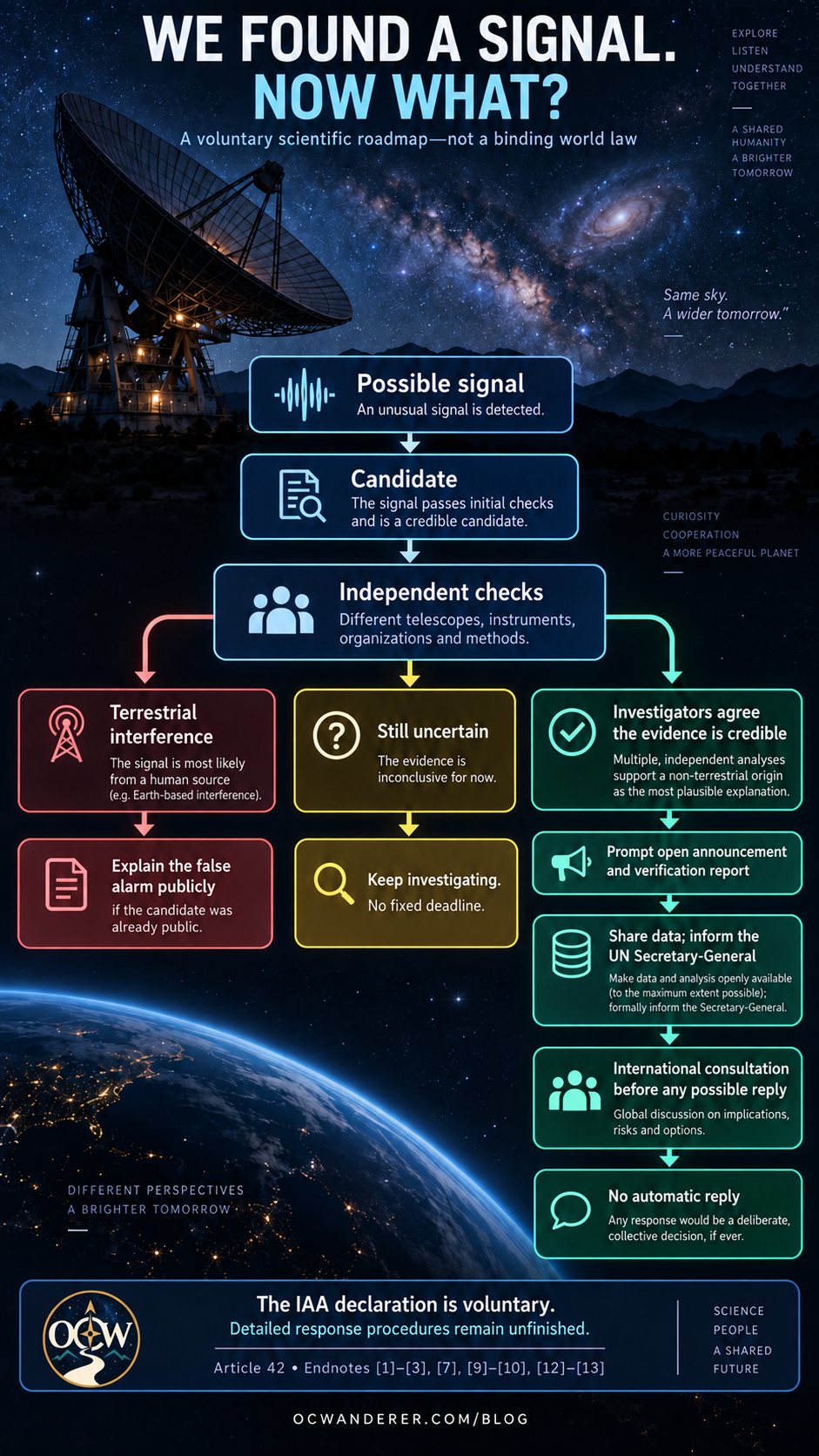
So what would happen if we detected an alien signal tomorrow?
If a telescope recorded a promising signal tomorrow, I imagine the observatory filling with calls to other telescopes while questions arrive from reporters who have already heard. The checking could be lengthy or inconclusive; word of a candidate would not mean we had confirmed a neighbor. If confirmation did come, we would have evidence to share and a recommendation to consult before replying, with the consultation procedures still left to further agreement. I want to see that discovery, and I keep coming back to the human question it would open: who gets to speak for Earth? How Would a World Government Actually Form? Crisis, Conquest, or the Long Treaty
If you want to see what a survey crew does with the questions waiting for them back on Earth, start Destiny Among the Stars.
Endnotes
-
Sofia Z. Sheikh et al., “Analysis of the Breakthrough Listen signal of interest blc1 with a technosignature verification framework,” Nature Astronomy 5 (2021): 1153–1162. DOI. The observation was made on April 29, 2019 with the Parkes “Murriyang” radio telescope, near 982 MHz; the paper concludes that the tone was a product of local, time-varying interferers. ↩
-
International Academy of Astronautics, “Declaration of Principles Concerning the Conduct of the Search for Extraterrestrial Intelligence,” dated June 1, 2026, principle 1 (Handling Candidate Evidence). Text hosted by the SETI Institute. It replaces the 2010 declaration of the same name. ↩
-
International Academy of Astronautics, “Declaration of Principles” (2026), principle 3 (Communicating Verification): confirmation is by the consensus of the other investigators involved and to a degree of certainty the discoverers judge credible. Text. ↩
-
Observation date and publication date (October 25, 2021): Sheikh et al., note 1. Press date and the state of the analysis: “Alien Hunters Discover Mysterious Signal from Proxima Centauri,” Scientific American, December 18, 2020, which says the news leaked that day in the Guardian, that the tone was found in the autumn of 2020 in data gathered the year before, and that months of further analysis lay ahead. Author calculation: December 18, 2020 to October 25, 2021 is ten months and one week; April 29, 2019 to October 25, 2021 is about thirty months. ↩
-
“Declaration of Principles Concerning Activities Following the Detection of Extraterrestrial Intelligence” (1989), principle 2. Text hosted by the IAA SETI Permanent Committee. The same principle asks the discoverer to inform the other parties to the declaration and the relevant national authorities before any public announcement. ↩
-
Michael A. Garrett, Kathryn Denning, Leslie I. Tennen and Carol Oliver, “SETI Post-Detection Protocols: Progress Towards a New Version,” paper IAC-25-A4.2.4, arXiv:2510.14506 (2025). It gives the history: adopted in 1989, streamlined in 2010, and a task group set up in 2022 because the 2010 text predated a communications landscape shaped by the internet, social media and artificial intelligence. ↩
-
International Academy of Astronautics, “Declaration of Principles” (2026), principle 2 (Communicating and Sharing Information): private verification, rumors, and candidates later found to be earthly. Text. ↩
-
Jung Yul Kwon, Hannah L. Bercovici, Katja Cunningham and Michael E. W. Varnum, “How Will We React to the Discovery of Extraterrestrial Life?” Frontiers in Psychology 8, article 2308 (January 10, 2018). DOI. Participants were recruited in the United States through Amazon Mechanical Turk. The paper was published in 2018, and the newspaper report in Study 2 was a 1996 New York Times article. Author calculation: 501 + 256 = 757 participants, “about 750” in the text. Study 1 (N = 501): 5.14 percent of the words in participants’ answers expressed positive feeling and 1.32 percent negative, a ratio of 3.9. Study 2 (N = 256 who read the Mars article): 4.69 percent and 0.52 percent, a ratio of 9.0. The authors advise caution in generalizing beyond the United States and say intelligent life might lead to very different reactions. ↩
-
International Academy of Astronautics, “Declaration of Principles” (2026), principle 3 (Communicating Verification): the report to the public, the scientific community and the UN Secretary-General, and the peer-reviewed verification report with its underlying data. Text. ↩
-
International Academy of Astronautics, “Declaration of Principles” (2026), principle 7 (Communications with ETI following confirmed detection). Text. ↩
-
“Declaration of Principles Concerning Activities Following the Detection of Extraterrestrial Intelligence” (1989), principle 8: no response until international consultations have taken place, with the procedures left to a separate agreement, declaration or arrangement. Text. ↩
-
Garrett et al., note 6: the 1995 “Draft Declaration of Principles Concerning the Sending of Communications to Extraterrestrial Intelligence” was presented with the 1989 declaration to the UN Committee on the Peaceful Uses of Outer Space in 2000; the paper’s conclusion lists procedures for international consultations on reply transmissions as future work. ↩
-
International Academy of Astronautics, “Declaration of Principles” (2026), preamble (the principles guide individuals, institutions and organisations taking part in SETI) and note 2 (messages sent in advance of a confirmed detection are outside it; the previous post covers that choice). Text. Garrett et al., note 6, describe the 1989 declaration as a voluntary framework. ↩
-
Peter Hatfield and Leah Trueblood, “SETI and Democracy,” Acta Astronautica 180 (2021): 596–603. DOI; full text. Survation polled 2,000 UK residents aged 18 or older on September 2–5, 2019: team of scientists 39 percent, elected representatives 15 percent, planet-wide referendum 11 percent, citizens’ assembly of randomly selected adults 11 percent, don’t know 23 percent (the rounded figures sum to 99). The authors call the questions indicative. ↩